


About Moment of Inertia Calculation
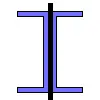
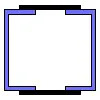
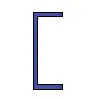
This moment of inertia calculator is a section geometry tool for determining the geometric properties of cross-sections: area, moment of inertia, section modulus, radius of gyration, and centroid coordinates. It supports circular, rectangular, I-shaped, T-shaped, channel, and angle sections, including built-up configurations.
These properties are used to analyze bending, stiffness, and stability of structural members, compare different profiles, and prepare engineering calculations. The results depend on the shape and dimensions of the cross-section, not on the material grade or strength.
Guidelines and Recommendations
Geometric Model and Assumptions
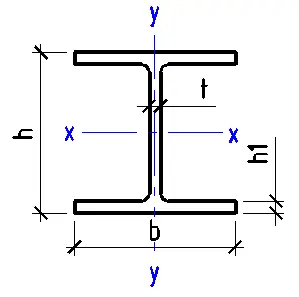
Input geometry. All dimensions are specified in millimeters. Solid sections are calculated using their outer boundaries. For hollow sections, the internal void is subtracted from the outer area. Complex profiles are represented as combinations of rectangular elements corresponding to webs and flanges.
Assumptions. Webs and flanges are assumed to be straight, with constant thickness and right angles at their intersections. Rounded corners, fillet radii, flange slopes, and local manufacturing details are not considered. Therefore, the properties of actual hot-rolled or cold-formed profiles may differ slightly from the calculated values.
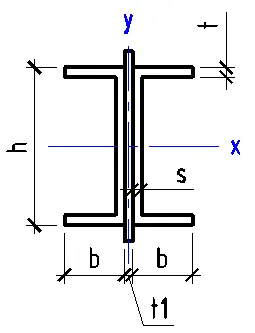
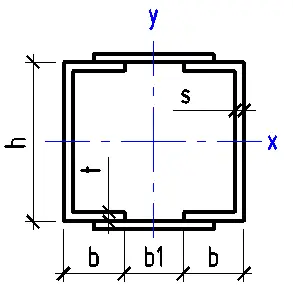
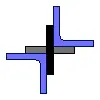
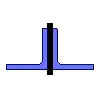
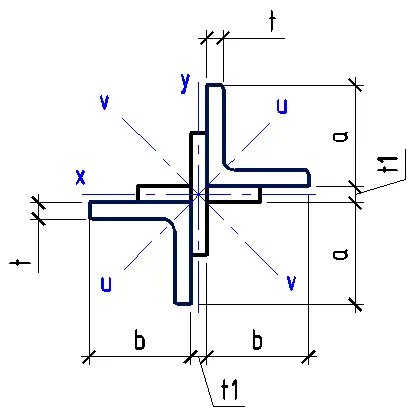
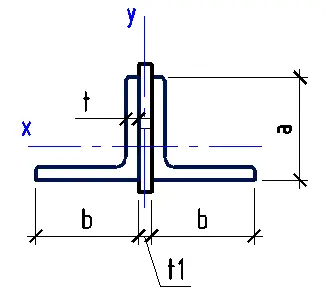
Built-up sections. For paired channels and angles, the positions of individual profiles and the specified distances between them are taken into account. When calculating paired angles, the thickness of the separating plate determines the spacing between the profiles, but the plate area is excluded from the cross-section. For the configuration of two channels with a solid central plate, the plate area is included in the calculations.
Coefficients. No partial safety factors, strength factors, or material correction factors are applied in the geometric calculations. Standard geometric formulas use the mathematical constant π ≈ 3.141593. Calculations are performed without intermediate rounding, and the final values are displayed with up to 6 significant digits.
Cross-Sectional Area and Centroid
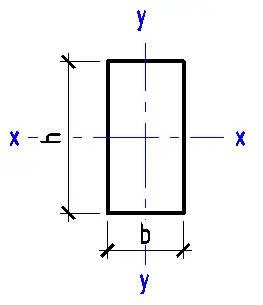
Cross-sectional area A is expressed in mm2 and calculated as the sum of the areas of the individual elements. For example, for a solid rectangle of width b and height h:
A = b × h
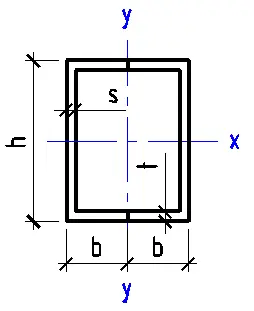
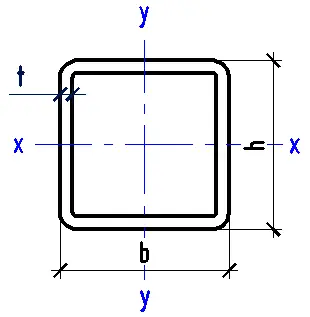
For a rectangular hollow section with uniform wall thickness t, the inner rectangle is subtracted from the outer rectangle:
A = b × h - (b - 2t) × (h - 2t)
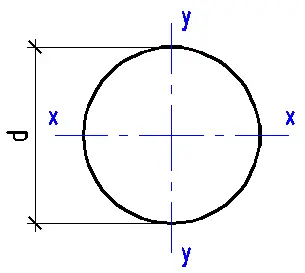
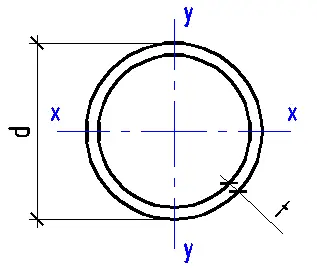
For a circular section with diameter D, the formula is A = π × D2 / 4. For a circular hollow section, the inner diameter is calculated as d = D - 2t, giving:
A = π × (D2 - d2) / 4
Centroid coordinates are determined from the area-weighted positions of the centers of the individual elements. The area of each element serves as its weighting factor. For the horizontal coordinate:
Xc = Σ(Ai × xi) / ΣAi
The vertical coordinate Yc is calculated in the same way. Here, Ai represents the area of an element in mm2, while xi and yi are the coordinates of its center in mm. The resulting coordinates are expressed in mm relative to the leftmost and bottommost boundaries of the cross-section.
Moments of Inertia About Centroidal Axes
Moments of inertia Ix and Iy describe the distribution of cross-sectional area about the horizontal and vertical centroidal axes. Their unit is mm4. The farther the area elements are located from the corresponding axis, the greater the moment of inertia.
For a solid rectangle:
Ix = b × h3 / 12
Iy = h × b3 / 12
For a circular section, the moments of inertia about both centroidal axes are equal:
Ix = Iy = π × D4 / 64
For a circular hollow section, the moment of inertia of the inner void is subtracted from that of the outer circle:
Ix = Iy = π × (D4 - d4) / 64
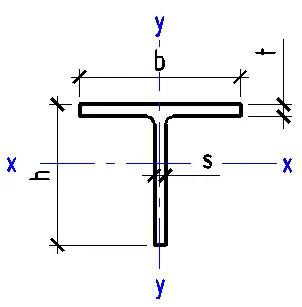
Built-up profiles are calculated using the parallel axis theorem (Steiner's theorem). First, the moment of inertia of each rectangular element about its own centroidal axis is determined. The contribution from the distance between the element's centroid and the overall centroid is then added:
Ix = Σ(Ix,i + Ai × Δyi2)
Iy = Σ(Iy,i + Ai × Δxi2)
Here, Δxi and Δyi are the distances from the centroid of each element to the corresponding coordinate of the overall centroid, expressed in mm. This principle is applied to I-sections, T-sections, channels, angles, and their built-up configurations.
Section Modulus and Radius of Gyration
Section modulus W is calculated by dividing the moment of inertia by the distance from the centroidal axis to the most distant point of the section in the corresponding direction. The result is expressed in mm3:
Wx = Ix / cy,max
Wy = Iy / cx,max
Here, cy,max and cx,max are the maximum distances from the corresponding centroidal axes to the extreme fibers of the cross-section, expressed in mm. If the distances on opposite sides of an axis are unequal, the larger distance is used for the overall section modulus, resulting in the smaller W value.
For T-sections, separate section moduli are also calculated for the top and bottom edges because the centroid is generally located at different distances from them.
Radius of gyration i is a geometric property describing the distribution of area about a centroidal axis and is expressed in mm:
ix = √(Ix / A)
iy = √(Iy / A)
Thus, the radius of gyration depends only on the area and the corresponding moment of inertia. For the same cross-sectional area, a larger radius of gyration indicates that the material is distributed farther from the axis on average.
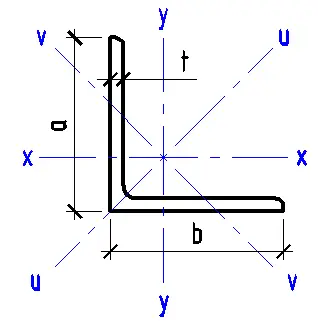
Principal Axes and Properties of Angle Sections
Product of inertia Ixy describes the combined distribution of area relative to two centroidal axes. For a built-up section, it is calculated by summing the products of the individual element areas and the offsets of their centroids in both coordinate directions:
Ixy = Σ(Ai × Δxi × Δyi)
Principal moments of inertia are the maximum and minimum moments of inertia about mutually perpendicular centroidal axes. They are calculated from Ix, Iy, and Ixy:
Imax,min = (Ix + Iy) / 2 ± √(((Ix - Iy) / 2)2 + Ixy2)
The plus sign gives the maximum principal moment, while the minus sign gives the minimum. The principal axis rotation angle θ is determined from the relationship between Ix, Iy, and Ixy and is expressed in degrees.
For the minimum principal axis, the radius of gyration imin = √(Imin / A) and section modulus Wmin = Imin / cmax are also calculated, where cmax is the maximum distance from this axis to the cross-sectional boundary.
Geometric Constraints and European Standards
Valid dimensions. Lengths, diameters, and thicknesses must define a geometrically possible cross-section. For example, a circular hollow section requires 2t < D, while a rectangular hollow section must satisfy both 2t < b and 2t < h. If the dimensions violate the geometric constraints, numerical results are not displayed.
European standards. The following standards are commonly used to compare the geometry and dimensions of actual steel profiles:
- EN 10365:2026 "Hot rolled steel channels, I and H sections - Dimensions and masses" - nominal dimensions of standard hot-rolled profiles.
- EN 10056-1:2017 "Structural steel equal and unequal leg angles - Part 1: Dimensions" - geometric dimensions of hot-rolled steel angles.
- EN 10219-2:2019 "Cold formed welded steel structural hollow sections - Part 2: Tolerances, dimensions and sectional properties" - dimensions and geometric properties of structural hollow sections.
- EN 1993-1-1 "Eurocode 3 - Design of steel structures - Part 1-1: General rules and rules for buildings" - application of cross-sectional properties in steel structural design.
The calculator uses analytical geometric relationships rather than tabulated section properties. Therefore, when comparing the results with the standard properties of a particular product, differences in the actual profile geometry should be considered, especially fillet radii and corner shapes.
FAQs
Why can two sections with the same area have different moments of inertia?
Cross-sectional area indicates the amount of material, while the moment of inertia also depends on how that material is distributed relative to the axis. If the same area is positioned farther from the centroidal axis, the moment of inertia increases. This is why I-sections, hollow sections, and solid rectangular sections have different geometric properties even when their areas are equal.
Why are the section moduli about the x and y axes different?
The section moduli Wx and Wy depend on the corresponding moments of inertia and the distances to the extreme points of the cross-section. In asymmetric or elongated profiles, the material distribution differs between the horizontal and vertical directions. Therefore, Wx and Wy are usually different, while they are equal for circular sections.
How does wall thickness affect the properties of a hollow section?
Increasing wall thickness while keeping the outer dimensions constant increases the cross-sectional area, moments of inertia, and section moduli. However, the relationship is nonlinear because the dimensions of the internal void also change with wall thickness. Therefore, doubling the wall thickness does not necessarily double the moment of inertia.
Why are principal moments of inertia calculated for angle sections?
For a single equal-leg or unequal-leg angle, the centroidal axes parallel to its legs generally do not coincide with the principal axes of inertia. Therefore, the maximum and minimum principal moments and the principal axis rotation angle are also calculated. These values identify the directions of maximum and minimum geometric resistance to bending.
Why might the calculated section properties differ from manufacturer data?
Manufacturer tables often account for rounded corners, flange slopes, and other features of specific hot-rolled or hollow section series. The calculator uses idealized geometry with straight webs and flanges. Therefore, differences from tabulated moments of inertia and section moduli may occur even when the nominal outer dimensions are identical.