

About Linear Expansion Coefficient Calculation
This linear expansion calculator determines linear thermal expansion or contraction and the resulting length change of an element when its temperature changes. The calculation is based on the initial length, initial and final temperatures, and the linear expansion coefficient of the material, and can be used for steel, aluminum, brass, concrete, polymers, and other materials.
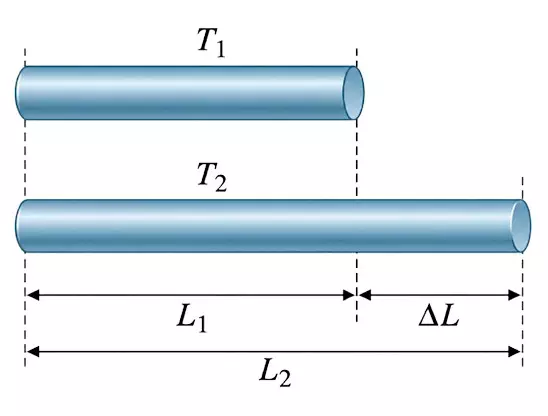
The result shows the length change ΔL in millimeters and the element length L2 at the final temperature. A positive ΔL means the element becomes longer, while a negative value means it becomes shorter.
Guidelines and recommendations
Calculation algorithm
Temperature difference. First, the temperature change between the final and initial states is calculated:
ΔT = T2 - T1
The temperatures T1 and T2 are entered in °C. If the final temperature is higher than the initial temperature, ΔT is positive. During cooling, ΔT is negative. Temperatures below -273.15 °C are treated as invalid.
Length change. Linear thermal deformation is calculated from the initial length L1, the temperature difference ΔT, and the linear expansion coefficient α:
ΔL = α · L1 · ΔT / 106
In the calculator, the length L1 is entered in millimeters, while the coefficient α is expressed in 10-6 1/°C. Dividing by 106 converts the tabulated coefficient into its standard form and gives ΔL directly in millimeters.
Final length. After the thermal length change is calculated, the element length at the final temperature is determined:
L2 = L1 + ΔL
When the element is heated, a positive ΔL increases the initial length. When it is cooled, a negative ΔL automatically reduces it.
Linear expansion coefficients
Coefficient α. It indicates how much the relative length of a material changes when its temperature changes by 1 °C. The higher the value of α, the greater the thermal length change for the same L1 and ΔT.
The calculator uses the following α values in 10-6 1/°C:
- carbon steel -
11.7, stainless steel -16, iron -12.2, gray cast iron -10; - aluminum -
23.8, bronze -17.5, brass -18.4, copper -16.5, tin -26.7, zinc -29; - gold -
14.2, silver -19.5, platinum -9, titanium -9; - concrete -
12, reinforced concrete -12, lightweight concrete blocks -10, aerated concrete blocks -8; - clinker brick -
3.5, calcium silicate brick -8, cement mortar -10, lime mortar -9; - wood parallel to the grain -
5, glass -8.1, fiberglass reinforcement -10, carbon fiber composite -0.5; - polyamide -
110, polyvinyl chloride -80, polystyrene -75, polyethylene -200.
Tabulated value. The coefficient for the selected material is inserted automatically, but it can be changed manually. This is useful when a more accurate expansion coefficient is known for a specific grade, alloy, composition, or temperature range from technical documentation.
Material dependence. The listed coefficients are typical calculation values. The actual α may depend on chemical composition, material structure, fiber or reinforcement direction, and temperature range, so for critical calculations it is preferable to use a value specified for the exact material.
Choosing the temperature range
Initial temperature. This is usually taken as the temperature of the element in its reference state, for example during installation, manufacture, or measurement of the initial length.
Final temperature. To evaluate the maximum movement, several temperature scenarios are often considered separately. For example, calculations can be performed for the highest and lowest expected temperatures and the absolute values |ΔL| can then be compared.
Design movement. If several possible temperature conditions are considered for a structure, the largest absolute value of ΔL among the analyzed scenarios is commonly used as the governing thermal movement.
Calculation assumptions
Linear relationship. The calculation assumes that the coefficient α remains constant throughout the specified temperature range and that the length change is proportional to ΔT.
Uniform temperature. The entire element is assumed to be at the same temperature. Local temperature differences along the length or across the section are not included in the formula.
Initial length. The formula uses the element length at temperature T1. If an element consists of sections made from different materials or with different coefficients, each uniform section is calculated separately and the resulting length changes are added with their signs.
Calculation precision. Intermediate calculations are performed without forced rounding. Main results in millimeters are displayed to three decimal places, while very small non-zero changes below 0.001 mm may be shown with greater precision.
Related European standards
EN 1991-1-5, Eurocode 1 "Actions on structures. Part 1-5: Thermal actions". This standard is used for determining thermal actions on structures and selecting design temperature conditions.
EN 1990, Eurocode "Basis of structural design". It establishes general design principles, combinations of actions, and requirements for structural reliability.
EN 1992-1-1, Eurocode 2 "Design of concrete structures. General rules and rules for buildings". It contains provisions for reinforced concrete structures, including material properties used when thermal deformation is considered.
EN 1993-1-1, Eurocode 3 "Design of steel structures. General rules and rules for buildings". It is used for the design of steel structures and includes steel properties relevant to thermal effects.
EN 1995-1-1, Eurocode 5 "Design of timber structures. General rules and rules for buildings". It is used for the design of timber elements and for determining relevant material properties.
FAQs
How do I choose the linear expansion coefficient for a specific material?
For a preliminary calculation, the tabulated value provided by the calculator can be used. If the exact steel grade, alloy, polymer, or other material is known, it is preferable to use the α value from the manufacturer's technical documentation and enter it manually.
Why does the same temperature difference produce a different length change?
Linear thermal expansion is proportional to both the initial length and the expansion coefficient α. Therefore, a longer element or a material with a higher coefficient will undergo a greater length change for the same ΔT.
How is length change calculated during cooling?
The final temperature T2 is entered below the initial temperature T1. In that case, both ΔT and ΔL become negative, which represents a reduction in element length.
How should the temperature range be selected for an outdoor element?
The temperature of the reference state and the expected extreme service temperatures are commonly considered. Calculations for maximum heating and maximum cooling are performed separately, and the resulting length changes are then compared.
Why can a tabulated expansion coefficient differ from a reference value?
The linear expansion coefficient depends on the exact composition and condition of the material and can also vary with temperature. Different references may therefore provide slightly different values, so for a more accurate calculation the coefficient for the specific material grade and temperature range should be used.