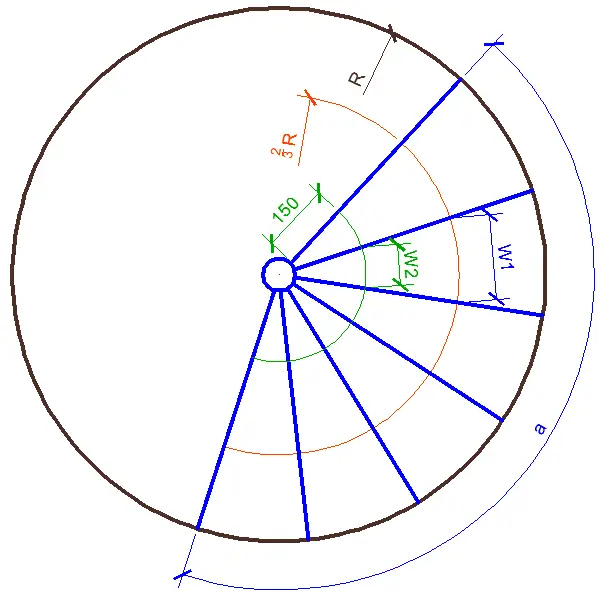
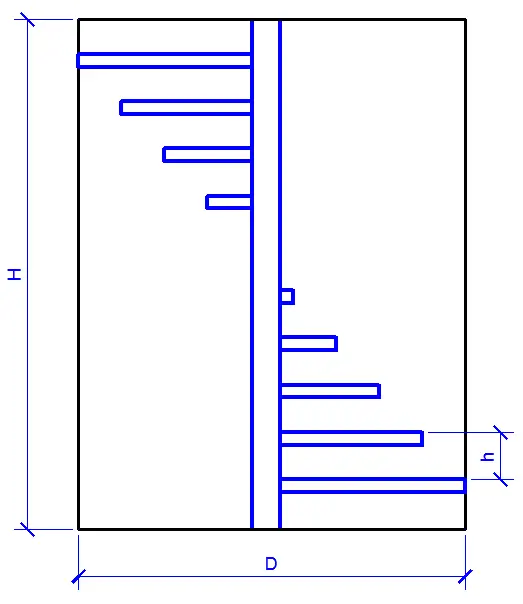
| Name | Value | Note |
|---|---|---|
| Step height, h | mm | |
| Step length along the radius | mm | |
| Angle per step, α | ° | |
| Step width along the walking line, w1 | mm | |
| Step width 150 mm from the central post, w2 | mm | |
| Step formula, 2h + w1 | mm | |
| Rise per revolution, H360 | mm | |
| Headroom between stair turns | mm |


About Spiral Stair Calculation
The Spiral Stair Calculator performs step and dimension calculations for a spiral staircase with a central post: step rise, radial step length, angle between adjacent steps, tread width along the walking line and near the post, step proportion, rise per full revolution, and headroom between stair turns. The calculation assumes that identical steps are distributed evenly by angle over the specified total rotation.
The calculated dimensions help coordinate the staircase height, diameter, number of steps, and total rotation angle. Practical ranges for step rise and tread width, the step formula, and a minimum headroom guideline are used to evaluate the resulting geometry.
Guidelines and Recommendations
Calculation Model and Main Assumptions
Geometric model. The staircase is treated as a regular spiral around a vertical central post. The outside staircase diameter D and central post diameter d are entered in millimeters, the total rotation angle a in degrees, the number of steps n is an integer, and all steps are assumed to have the same thickness t.
Radial step length. The available length from the surface of the central post to the outside edge of the staircase is calculated as half the difference between the two diameters:
(D - d) / 2
For the calculation to continue, this length must be at least 150 mm, because one of the reference tread widths is measured exactly 150 mm from the surface of the central post.
Angle per step. The total rotation angle is divided evenly between all steps:
α = a / n
The calculation requires a total rotation angle of at least 90°, while the angle of one step must be greater than 0° and less than 180°. The central post diameter must be at least 30 mm, and the outside staircase diameter must be greater than the post diameter.
Walking Line and Tread Width
Walking line position. The width of a wedge-shaped step changes from the center toward the outside edge, so a reference walking line is used to evaluate comfort. If the radial step length does not exceed 1000 mm, the walking line is placed halfway across the available width:
r = d / 2 + (D - d) / 4
If the radial step length is greater than 1000 mm, the walking line is taken at a distance of 500 mm from the surface of the central post:
r = d / 2 + 500
Tread width along the walking line. The step width w1 is calculated as the arc length occupied by one step at the reference radius r. The angle α is converted from degrees to radians as part of the calculation:
w1 = r · α · π / 180
Arc length is used because movement on a spiral staircase follows a curved path rather than a straight chord between the edges of the step.
Tread width near the post. The calculator also determines the step width w2 at a distance of 150 mm from the surface of the central post:
w2 = (d / 2 + 150) · α · π / 180
This value describes the geometry of the narrow part of the step and is shown as a reference dimension. No separate limiting range for w2 is applied when evaluating the result.
Step Rise and Headroom Between Stair Turns
Step rise. If n represents the number of individual steps, the upper floor level creates one additional rise. Therefore, the total staircase height H is divided by n + 1:
h = H / (n + 1)
Rise per revolution. After determining the step rise h and the angle per step α, the vertical rise of the staircase over a full 360° revolution is calculated:
H360 = h · 360 / α
Headroom. To obtain the vertical distance from the top surface of a step to the underside of the step one full turn above it, the step thickness t is subtracted from the rise per revolution:
Hheadroom = H360 - t
Increasing the step thickness therefore reduces the available headroom by the same amount, while it does not change the tread width or step rotation angle.
Comfort Checks and Recommendation Logic
Step rise. A practical guideline range of 150-200 mm is used. If the calculated value is below 150 mm, the calculator recommends decreasing the number of steps; if it is above 200 mm, it recommends increasing the number of steps.
Tread width along the walking line. A guideline range of 200-400 mm is used for w1. A value below this range indicates a short tread along the walking path, while a value above it indicates an excessively long step.
Step formula. To evaluate the relationship between step rise and tread width, the calculator uses the common ergonomic step formula:
2h + w1
The calculator uses a guideline range of 600-660 mm. If the result is below 600 mm, increasing the number of steps is recommended; if it is above 660 mm, decreasing the number of steps is recommended.
Headroom. A guideline of at least 2000 mm is used for the vertical distance between the top of a step and the underside of the stair turn above. If the result is lower, the applicable local building requirements should be checked.
Rotation angle recommendation. The calculator recommends reducing the total rotation angle when 2h + w1 > 660 mm while the step rise remains within 150-200 mm, and also when w1 > 400 mm together with h < 150 mm. It recommends increasing the rotation angle when 2h + w1 < 600 mm with a step rise within the normal range, or when w1 < 200 mm together with h > 200 mm.
Result rounding. Linear dimensions are displayed rounded to the nearest whole millimeter. The angle per step is displayed to 0.1°, while the internal calculations use unrounded values.
Relation to European Standards
Geometric guidelines. The ranges 150-200 mm, 200-400 mm, 600-660 mm, and the 2000 mm headroom value are used as practical guidelines for preliminary spiral staircase dimension calculation. Mandatory staircase dimensions are established by national building regulations in European countries, so specific limits may differ.
EN 1990 "Eurocode: Basis of structural design". This European standard establishes general principles for structural reliability, safety, and serviceability and provides the basis for subsequent structural design of the staircase.
EN 1991-1-1 "Eurocode 1: Actions on structures. Part 1-1: General actions. Densities, self-weight, imposed loads for buildings". This standard defines principles for considering permanent and imposed loads on building elements, including stair structures, during structural design.
FAQs
Why is the step rise calculated as H / (n + 1)?
The entered value n represents the number of individual spiral staircase steps, while the upper floor forms the next elevation level. This creates n + 1 equal vertical rises between the lower and upper floor levels.
Why does the walking line position depend on the staircase diameter?
On a relatively narrow spiral staircase, the natural walking path is approximately halfway across the available width, so the midpoint is used when the radial step length is up to 1000 mm. For a wider staircase, the reference walking line is fixed at 500 mm from the surface of the central post so that increasing the outside radius does not move the calculated walking path too far outward.
Why is the tread width calculated 150 mm from the central post?
A wedge-shaped step becomes narrower toward the center of the staircase. The value w2 shows the actual tread width at a fixed distance of 150 mm from the post and makes it possible to compare different spiral staircase designs at the same reference location.
What does the formula 2h + w1 indicate?
The formula relates the vertical step rise to the horizontal tread length along the walking line. A value within 600-660 mm is used as a practical guideline to avoid combining a high step with a short tread or a low step with an excessively long tread.
How can I increase the headroom between stair turns?
Headroom depends on the rise per full revolution H360 and the step thickness. It can be changed by adjusting the total rotation angle or the number of steps, after which the step rise h, tread width w1, and step formula 2h + w1 should be checked together because these dimensions are interdependent.