

About Bond Beam Calculation
This Bond Beam Concrete and Rebar Calculation Tool estimates the materials required to construct a reinforced concrete bond beam. It calculates concrete volume, the total length and weight of longitudinal rebar, the number of stirrups, their cutting lengths, and the total weight of the reinforcement cage.
The calculation is based on the geometric dimensions of the bond beam and the selected reinforcement arrangement. The results help estimate material requirements, prepare quantities for purchasing, and compare different reinforcement configurations.
Guidelines and Recommendations
Concrete Volume Calculation
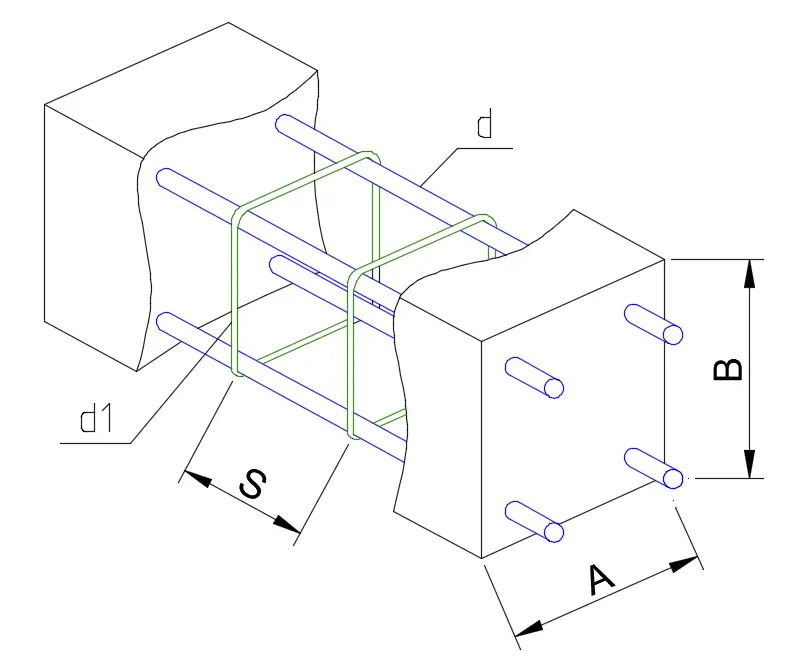
Geometric volume. The bond beam is treated as a rectangular solid with a constant cross-section. The cross-sectional area is determined by multiplying width A by height B, both specified in millimetres. The resulting area is multiplied by the total length L in metres.
V = A × B × L / 1 000 000
Here, V is the concrete volume in m3. Dividing by 1 000 000 converts the product of the dimensions into cubic metres.
For example, a bond beam 200 mm wide, 200 mm high, and 24 m long has a concrete volume of 0.96 m3. The calculation uses the full geometric cross-section without subtracting the volume occupied by steel reinforcement. No additional allowance for concrete waste is added automatically.
Length and Weight of Longitudinal Rebar
Total length. The number of longitudinal bars n is multiplied by the total bond beam length L in metres. Each longitudinal bar is assumed to extend along the entire calculated length.
Llong = n × L
For example, four longitudinal bars along a 24 m bond beam require 96 m of rebar. This is the theoretical length, excluding additional lengths for splices, anchorage, and cutting waste.
Theoretical weight. Rebar weight is calculated from the circular cross-sectional area of the bar, its total length, and a steel density of 7850 kg/m3. For bar diameter d in millimetres and length in metres, the following formula is used:
Mlong = Llong × π × d2 / 4 × 0.00785
The coefficient 0.00785 accounts for steel density and the conversion of cross-sectional area from mm2 to m2. The resulting weight is expressed in kilograms. A 12 mm diameter reinforcing bar weighs approximately 0.888 kg per metre.
Calculating the Number of Stirrups
Number of stirrups. The total bond beam length is converted from metres to millimetres and divided by the specified stirrup spacing S. The result is rounded up to the nearest whole number of intervals, and one additional stirrup is included to account for both ends of the section.
Nst = ⌈L × 1000 / S⌉ + 1
Here, Nst is the number of stirrups. Rounding up ensures that the calculated distance between adjacent stirrups does not exceed the specified spacing. The formula applies to a single straight section with stirrups at both ends.
For example, a 10 m section with 1000 mm stirrup spacing requires 11 stirrups. Reducing the spacing to 990 mm increases the requirement to 12 stirrups. For several separate sections, the quantities should be calculated individually because each section has its own end stirrups.
Calculating the Cutting Length of One Stirrup
Concrete cover. The cover distance c is measured from the outer concrete surface to the outer surface of the stirrup. To determine the cutting length, the stirrup perimeter is measured along the centreline of the reinforcing bar. Therefore, both twice the concrete cover and the stirrup bar diameter d1 are taken into account when calculating the dimensions inside the concrete cross-section.
Rectangular stirrup. With four or more longitudinal bars, a rectangular stirrup arrangement is assumed. Its centreline width is A - 2c - d1, while its centreline height is B - 2c - d1. A closing allowance is added to twice the sum of these dimensions.
lst = 2 × [(A - 2c - d1) + (B - 2c - d1)] + 12d1
Triangular stirrup. When three longitudinal bars are used, a triangular reinforcement arrangement is assumed, with one upper bar and two lower bars. The triangle apex is positioned at the centre of the cross-section width, while its base runs near the bottom of the bond beam. The cutting length is calculated as the sum of the base, two inclined sides, and a closing allowance.
To determine the geometry, the distance from the outer concrete surface to the stirrup centreline is calculated first:
t = c + d1 / 2
The triangular stirrup length is then determined using the following formula:
lst = (A - 2t) + 2 × √[(A / 2 - t)2 + (B - 2t)2] + 12d1
All dimensions in the stirrup length formulas are specified in millimetres, and the resulting cutting length is expressed in millimetres.
Closing allowance. Both calculation methods include an additional length equal to 12 times the stirrup bar diameter. For example, an 8 mm diameter stirrup receives an allowance of 96 mm. This is a fixed calculation assumption for preliminary material estimation, not a universally prescribed connection length. The actual cutting length depends on the closing detail and bending requirements.
Total Stirrup Length and Weight
Total length. The calculated cutting length of one stirrup is multiplied by the number of stirrups. Since the cutting length is determined in millimetres, the result is divided by 1000 to convert it into metres.
Lst = Nst × lst / 1000
Stirrup weight. The same theoretical steel weight calculation used for longitudinal rebar is applied. The total stirrup length is multiplied by the circular cross-sectional area of the reinforcing bar with diameter d1 and the coefficient 0.00785.
Mst = Lst × π × d12 / 4 × 0.00785
The total reinforcement cage weight is determined by adding the weight of the longitudinal bars and the weight of all stirrups.
Mtotal = Mlong + Mst
Allowance for Additional Longitudinal Rebar
Additional allowance. Longitudinal bar splices, anchorage lengths, and cutting waste are not calculated automatically. An additional percentage p can be specified to account for these requirements. For example, with a 10% allowance, the calculated longitudinal rebar length is multiplied by 1.10.
Llong,extra = Llong × (1 + p / 100)
The weight of longitudinal rebar including the allowance increases by the same proportion. To calculate the total reinforcement cage weight, the original calculated stirrup weight is added to the increased longitudinal rebar weight.
Mtotal,extra = Mlong × (1 + p / 100) + Mst
The percentage applies only to longitudinal rebar. Stirrup quantities and cutting lengths are calculated separately and already include a closing allowance. No additional allowance for stirrup cutting waste is included. When the percentage is 0%, the original theoretical material quantities are used without any increase.
Calculation Precision and Input Validation
Calculation precision. Intermediate geometric values and weights are calculated without preliminary rounding. The displayed concrete volume is rounded to four decimal places, the cutting length of one stirrup to one decimal place, and other lengths and weights to two decimal places. Insignificant trailing zeros are removed.
Geometry validation. Before calculating, the available space inside the concrete cross-section is checked to determine whether the stirrup and longitudinal bars can fit, taking their diameters and concrete cover into account. If the specified dimensions cannot accommodate the selected reinforcement cage, no results are displayed.
Practical Guidelines and European Standards
Bond beam dimensions. In low-rise construction, bond beams with widths and heights of approximately 150-300 mm are commonly used. Actual dimensions depend on wall thickness, the way supported structural elements transfer their loads, and project requirements.
Concrete cover. Values of 25-35 mm are often used for preliminary estimates. The required cover depends on environmental exposure, durability requirements, fire resistance, and structural details. Concrete cover must be specified in the project in accordance with the applicable National Annex to Eurocode 2.
Longitudinal and transverse reinforcement. Small reinforced concrete bond beams often use four longitudinal bars with diameters of approximately 10-14 mm and stirrups with diameters of 6-8 mm. Common preliminary stirrup spacing values are 150-300 mm. Closer transverse reinforcement spacing may be required in certain zones. These ranges are practical guidelines rather than universal code limits.
Applicable standards. In European practice, the dimensions, concrete cover, and reinforcement of reinforced concrete elements are specified with reference to EN 1992-1-1 "Eurocode 2: Design of Concrete Structures - Part 1-1: General Rules and Rules for Buildings", together with the applicable National Annex. Concrete requirements are covered by EN 206 "Concrete - Specification, Performance, Production and Conformity". EN 10080 "Steel for the Reinforcement of Concrete - Weldable Reinforcing Steel - General" applies to weldable reinforcing steel. The calculator's assumptions, including the fixed closing allowance of 12 stirrup diameters, should not be interpreted as values prescribed by these standards.
FAQs
Why Is One Additional Stirrup Included in the Calculation?
Stirrups are distributed along a straight section, including both its beginning and end. The number of intervals is calculated by dividing the length by the spacing and rounding up, while the number of stirrups is always one greater than the number of intervals. Therefore, a 10 m section requires 11 stirrups at 1 m spacing, but 12 stirrups at 0.99 m spacing.
Why Does Stirrup Length Depend on the Number of Longitudinal Bars?
A triangular reinforcement arrangement is used with three longitudinal bars, while a rectangular arrangement is used with four or more bars. These arrangements have different transverse reinforcement perimeters, resulting in different cutting lengths and weights. In both cases, the same closing allowance of 12 stirrup diameters is added to the geometric length.
How Does Concrete Cover Affect the Amount of Rebar?
Increasing concrete cover reduces stirrup dimensions because the stirrup perimeter is positioned farther from the outer concrete surfaces. This reduces the cutting length of each stirrup and the total weight of transverse reinforcement. The geometric concrete volume and the total length of longitudinal bars remain unchanged.
How Should Longitudinal Rebar Splices and Cutting Waste Be Accounted For?
The basic longitudinal bar length is calculated without connections or waste. Additional requirements are included through a percentage allowance that increases the calculated length and weight. A value of 5-10% may be used as a preliminary guideline, but the actual allowance depends on the supplied bar lengths, connection details, and cutting plan.
How Can Materials Be Calculated for Several Separate Bond Beam Sections?
If a bond beam consists of separate straight sections, it is advisable to calculate each section individually. Each section requires stirrups at both ends, so calculating only from the combined length may underestimate the total number of stirrups. After the individual calculations, the concrete volumes, rebar lengths, and weights are added together.