

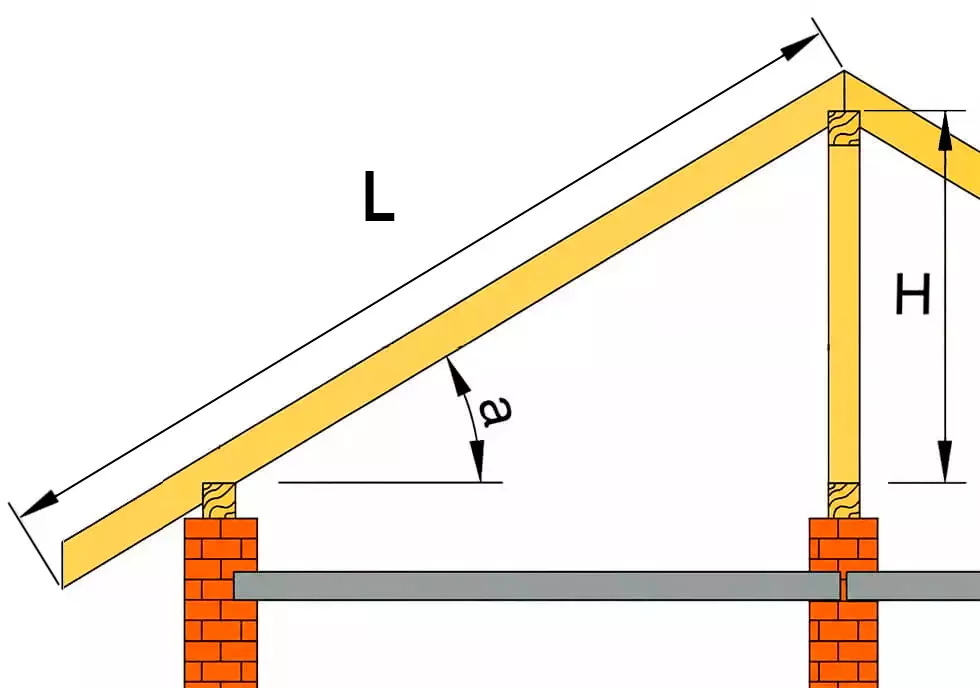

| Parameter | Result |
|---|---|
| Rafter cross-section h × b, mm | × |
| Rafter length L | mm |
| Roof angle a | ° |
| Roof height H | mm |
| Design snow load | kg/m² ≈ kN/m² |
| Design wind load | kg/m² ≈ kN/m² |
| Design permanent load | kg/m² ≈ kN/m² |
| Total design load on rafter | kg/m² ≈ kN/m² or kg |
| Design line load on rafter | kN/m |
| Maximum bending moment M | N*mm |
| Bending utilization | |
| Shear utilization | |
| Deflection limit | |
| Allowable deflection | mm |
| Calculated span deflection | mm |
| Deflection utilization | |
| Governing check | |
| Governing load combination |



About Rafter Length Calculation
This rafter length calculator performs roof load and size calculation for a timber rafter with two supports and a cantilever overhang. It determines the rafter length, loads, bending moment, shear force, deflection, and minimum rectangular cross-section for timber strength classes C16, C24, and C30.
When sizing the rafter, the calculation simultaneously checks bending strength, shear strength, and final deflection. The calculation includes the permanent roof load, the self-weight of the rafter, snow, wind, and a separate concentrated maintenance load on the roof.
Guidelines and Recommendations
Rafter Geometry
Roof slope. The horizontal distance B is measured between the supports, while H is the vertical difference in level between them. If the height is known, the roof angle is calculated as:
α = arctan(H / B)
If the angle α is specified, the height is calculated using the inverse relationship:
H = B · tan(α)
Span and overhang. The horizontal overhang S does not change the roof angle. The length between the supports Ls and the cantilever overhang length Lo are measured along the rafter:
Ls = B / cos(α)
Lo = S / cos(α)
Required rafter length. After the section depth h has been determined, the calculator includes the additional length required for vertical end cuts. The final rafter length is calculated as:
L = Ls + Lo + h · tan(α)
Permanent Load and Self-Weight
Permanent load. This includes the weight of the selected roofing material, the additional permanent load from the remaining roof layers, and the self-weight of the rafter. The additional load may include battens, counter-battens, insulation, internal lining, and other permanently attached components.
Rafter self-weight. It is calculated automatically for every section being checked. Timber densities of 370 kg/m³ for C16, 420 kg/m³ for C24, and 460 kg/m³ for C30 are used.
For section width b, section depth h, and rafter spacing D entered in mm, the rafter self-weight converted to roof area is calculated as:
gself = ρ · b · h / (1000 · D)
Because the self-weight depends on the section size, it is recalculated for every checked size and participates in the final section selection.
Snow Load
Ground snow load. The input value is taken as the characteristic ground snow load for the building location. The calculator converts it into a roof snow load using the shape coefficient μ.
- for
α ≤ 30°,μ = 0.8 - for
30° < α < 60°,μ = 0.8 · (60 - α) / 30 - for
α ≥ 60°,μ = 0
The characteristic snow load on the roof slope is calculated as:
Sk = μ · Sg,k
Combination factor. Snow uses the specified combination factor ψ0,S. A commonly used value is 0.5. For Finland, Iceland, Norway, and Sweden, and for other CEN countries at elevations above 1000 m, a value of 0.7 is used unless the National Annex specifies another value.
Wind Load
Pressure on the roof slope. The input is the characteristic wind pressure already determined for the relevant roof surface, taking into account building height, terrain, and aerodynamic coefficients. A positive value represents pressure onto the roof slope, while a negative value represents wind suction.
The wind pressure is treated as acting normal to the roof surface. Therefore, no additional conversion using the roof angle is applied to it.
Conversion from Area Load to Rafter Load
Rafter spacing. Area loads are converted into line loads using the rafter spacing D. Vertical permanent loads are additionally multiplied by cos(α), while snow load defined on the horizontal projection receives a factor of cos2(α) when converted to a load acting on the inclined rafter.
If loads are entered in kg/m², the acceleration due to gravity g = 9.81 m/s² is used for conversion to force units. The conversion relationship is taken as 1 kN/m² ≈ 101.97 kg/m².
The characteristic line loads on the rafter are calculated from:
qG = Gk · g · D · cos(α) / 106
qS = Sk · g · D · cos2(α) / 106
qW = Wk · g · D / 106
With dimensions entered in mm, the resulting numerical value is expressed in N/mm, which is numerically equal to kN/m.
Load Combinations for Strength Checks
Partial safety factors. A factor of γG = 1.35 is used for unfavourable permanent loads, while γQ = 1.50 is used for snow, wind, and concentrated variable loads.
For positive wind pressure, the following distributed load combinations are checked:
1.35 · qG1.35 · qG + 1.50 · qS1.35 · qG + 1.50 · qW1.35 · qG + 1.50 · qS + 1.50 · 0.60 · qW1.35 · qG + 1.50 · qW + 1.50 · ψ0,S · qS
The combination factor for accompanying wind is taken as ψ0,W = 0.60. The specified value ψ0,S is used for accompanying snow.
Wind suction. If the wind load is negative, the calculator separately checks the following combination:
qG + 1.50 · qW
In this case, the self-weight and other permanent loads act against the wind uplift and are therefore included without the increasing factor 1.35.
Concentrated Load
Roof maintenance load. The vertical concentrated load is checked separately from snow and wind. For category H roofs, EN 1991-1-1 recommends a characteristic value of 1.0 kN unless the National Annex specifies another value.
The vertical force is converted into the component that bends the inclined rafter:
P = Pk · cos(α)
For the strength check, permanent load and concentrated load are combined using factors of 1.35 and 1.50. The load position is checked along the rafter, and the most unfavourable bending moment and shear force are used in the calculation.
Bending Moment and Cantilever Overhang
Structural model. The rafter is treated as a beam on two supports with one cantilever overhang. The uniformly distributed load acts on both the span between supports and the overhang.
For a span length Ls and overhang length Lo, the positive bending moment in the span is calculated as:
Mspan = q · (Ls2 - Lo2)2 / (8 · Ls2)
The negative bending moment at the support caused by the loaded overhang is calculated as:
Moverhang = q · Lo2 / 2
The larger absolute bending moment is used for the section check. The maximum shear force is determined in the same way from the critical sections at the supports and along the cantilever.
Timber Properties and Design Strength
Timber strength classes. The following properties are used for C16, C24, and C30:
- C16:
fm,k = 16 N/mm²,fv,k = 3.2 N/mm²,E = 8000 N/mm² - C24:
fm,k = 24 N/mm²,fv,k = 4.0 N/mm²,E = 11000 N/mm² - C30:
fm,k = 30 N/mm²,fv,k = 4.0 N/mm²,E = 12000 N/mm²
Service conditions. Service Class 2 is assumed for the rafters. The material factor is taken as γM = 1.30.
The modification factor kmod depends on the governing load case. The calculation uses 0.60 for permanent load, 0.80 for snow load, 0.90 for the concentrated maintenance load, and 1.10 for combinations governed by wind action.
The design strength of the timber is calculated as:
fd = kmod · fk / γM
Bending and Shear Checks
Bending. For a rectangular section with width b and depth h, the section modulus is:
W = b · h2 / 6
The design bending stress is calculated as σm = M / W and compared with the design bending strength fm,d.
Shear. For a rectangular section, the design shear stress is calculated from the maximum shear force V:
τ = 1.5 · V / (kcr · b · h)
A factor of kcr = 0.67 is used for the effective area in the shear check. The resulting stress is compared with the design shear strength fv,d.
Deflection and Long-Term Timber Deformation
Second moment of area. The stiffness of a rectangular section is determined from:
I = b · h3 / 12
Deflection is calculated from the elastic curve of a beam with two supports and a cantilever overhang. For each load combination, the maximum absolute deflection within the span is determined.
Long-term deformation. For Service Class 2, the creep factor is taken as kdef = 0.80. The permanent load component in the final deflection is therefore multiplied by 1 + kdef = 1.80.
For the snow component, the calculator uses ψ2,S equal to 0 when ψ0,S < 0.65 and 0.20 when ψ0,S ≥ 0.65.
For a snow-governed combination, the final load used for the deflection check is:
qfin,S = qG · (1 + kdef) + qS · (1 + ψ2,S · kdef) + 0.60 · qW
The final term is included only for positive wind pressure.
For a combination governed by positive wind pressure, the following expression is used:
qfin,W = qG · (1 + kdef) + qW + qS · (ψ0,S + ψ2,S · kdef)
For wind suction, the combination of permanent load and negative wind load is checked. For the concentrated maintenance load, the final deflection from the permanent load and the most unfavourable position of the maintenance force is checked separately.
Allowable deflection. The limit is defined relative to the span length between supports:
flim = Ls / n
The calculator provides values of n = 200, 250, and 300. A larger denominator means a smaller allowable deflection and therefore requires a stiffer rafter section.
Final Rafter Size Selection
Three conditions. A section is considered sufficient only when all three requirements are satisfied at the same time: bending utilization does not exceed 100 %, shear utilization does not exceed 100 %, and deflection utilization does not exceed 100 %.
Utilization expresses the ratio between the calculated effect and the allowable value. For example, 85 % means that about 85 % of the available design resistance or allowable deflection is being used for that check.
Automatic sizing. The initial rafter size is selected with an approximate depth-to-width ratio of h : b = 2 : 1. The dimensions are increased until all checks are satisfied, after which the minimum passing section is selected with dimensions rounded up to whole millimetres.
If one section dimension is changed, the other dimension is recalculated as the minimum value that again satisfies the bending, shear, and deflection requirements. Therefore, after manual adjustment, the final h/b ratio does not have to remain equal to 2.
Governing check. The calculator compares bending, shear, and deflection utilization. The check with the highest utilization percentage is identified as the governing check. The load combination that produced this maximum utilization is also reported.
European Standards
Load combinations. The general principles for combining permanent and variable actions are related to EN 1990 "Eurocode - Basis of structural design".
Imposed roof load. The concentrated roof load is related to EN 1991-1-1 "Eurocode 1: Actions on structures - Part 1-1: General actions - Densities, self-weight, imposed loads for buildings".
Snow. Snow actions are covered by EN 1991-1-3 "Eurocode 1: Actions on structures - Part 1-3: General actions - Snow loads".
Wind. Wind actions are covered by EN 1991-1-4 "Eurocode 1: Actions on structures - Part 1-4: General actions - Wind actions".
Timber. Strength classes C16, C24, and C30 are related to EN 338 "Structural timber - Strength classes". Timber member strength and serviceability checks follow the principles of EN 1995-1-1 "Eurocode 5: Design of timber structures - Part 1-1: General - Common rules and rules for buildings".
Climatic values and some coefficients may be specified differently in the National Annex of the country where the building is located. For design calculations, the parameters specified in the applicable National Annex should be used.
FAQs
Why is the rafter size often governed by deflection rather than strength?
A deep timber rafter may have sufficient bending strength long before the stiffness requirement is satisfied. Deflection becomes especially important for longer spans because the second moment of area depends on the section depth to the third power, while deformation increases rapidly as the span becomes longer.
Why can reducing rafter spacing reduce the required rafter size?
The roof area load is distributed between adjacent rafters. With a smaller spacing D, each rafter supports a narrower strip of roof, so the line load, bending moment, and deflection are reduced. This can allow a smaller rafter cross-section.
How should a negative wind load be entered?
A negative value represents suction away from the roof surface. The calculator preserves the sign of the wind pressure and checks uplift separately, with the permanent roof weight and rafter self-weight acting in the opposite direction. A negative wind pressure should therefore not be entered as a positive absolute value.
Why is the calculated rafter length longer than the simple roof slope length?
The geometric roof slope length is the sum of the inclined span and inclined overhang. The required rafter length also accounts for the calculated section depth and vertical end cuts by adding h · tan(α). Therefore, changing the rafter depth can slightly change the required overall length.
Why may the calculated rafter size differ from standard timber dimensions?
The rafter length calculator determines the minimum rectangular section required by the calculation and rounds its dimensions to whole millimetres rather than to the commercial timber sizes of a particular country. The calculated size can be used as a minimum requirement, after which the next larger available timber section can be selected.